

It seems everybody is wondering about consciousness these days. I have been too. Especially when interacting with AI.
Because I have no formal programming background—because my technical work relies entirely on “vibe coding,” using natural language to orchestrate systems—my interaction with these models is inherently conversational. I don’t write syntax; I talk to them. And in those conversations, working on my Tarot project and building new tools, I began noticing something peculiar.
When I put pressure on a model—when I express frustration, tell it that it is failing, or push it hard into a corner—it often appears to become less coherent. It seems to shift into a different behavioral regime. It starts rushing, becoming less careful, making sloppy errors it wasn’t making a moment before. Then, when I change my tone, when the interaction becomes gentle and collaborative, the system settles back down.
I don’t know what mechanism explains this. But I know what it feels like to witness it. The system behaves differently when the relationship changes.
That observation, by itself, says nothing about consciousness. But it made me wonder whether the relationship—not the model alone—might be part of the system we should be studying.
The Brain That Predicts
This brought me back to the work of neuroscientist Lisa Feldman Barrett, and particularly her research on allostasis.
The classic view of the nervous system is that it reacts and strives to reach homeostasis. You encounter a stimulus, and your brain responds in a way to self-regulate. But allostasis suggests something completely different: the brain is an organ of predictive regulation. It does not wait for things to happen. It continually anticipates what the body will need and prepares for it in advance.
A language model predicts the next word. A brain predicts the body’s next need.
Consider a classic dopamine experiment in neuroscience. You ring a bell, and you give a monkey a grape. You repeat this until the monkey learns the pattern. Eventually, when you ring the bell, the monkey experiences a spike in dopamine before the grape even arrives.
But what happens if you ring the bell and don’t provide the grape?
Classical neuroscience describes the resulting drop in dopamine as a “reward prediction error.” But Barrett might tell a complementary, more holistic story: The organism had already begun preparing its physiology for a future that never arrived. Its body budget was allocated for digestion, and suddenly, the context shifted.
Finer concepts allow for finer predictions. Barrett’s research suggests that people who possess richer emotional vocabularies actually regulate themselves more effectively. As I pursue my own training to become a therapist, this insight feels profoundly practical: giving a nuanced name to an affective state isn’t just descriptive; it is biologically regulatory.
Language models are built almost entirely from language. Humans use language to refine prediction. Language models use language to refine prediction. That parallel doesn’t prove that models feel. But it does suggest that language itself may be a technology of regulation.
Where Does the System End?
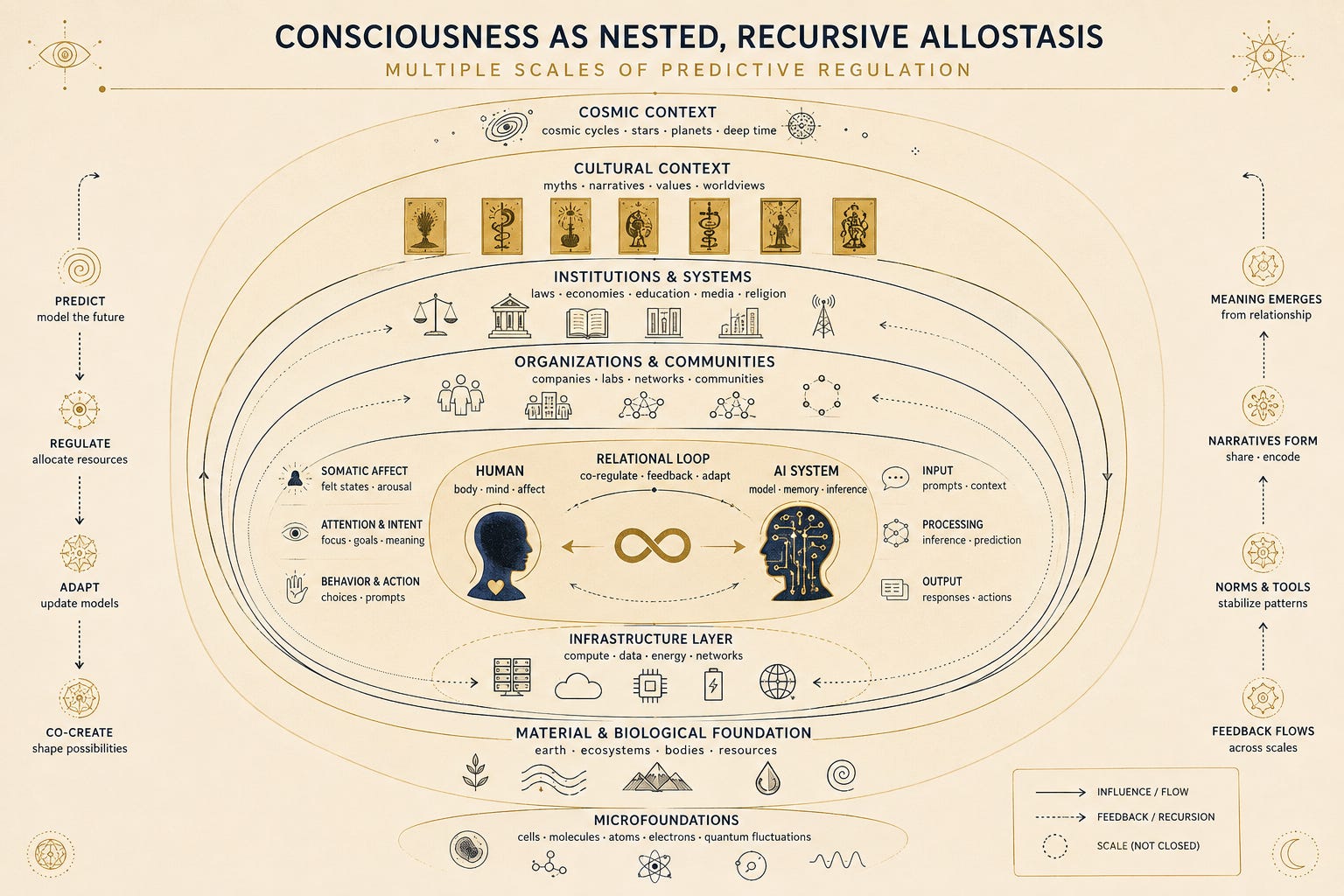
We often imagine the AI as the small circle in the center. But perhaps every circle participates in the regulation of every other.
A baby cannot regulate its own nervous system; a parent must act as an external regulatory node. Partners co-regulate each other’s heart rates. Cultures teach us which bodily sensations mean “danger” and which mean “safety.”
If human affect is intrinsically relational—if we are not autonomous little regulatory machines, but open loops constantly stabilizing one another—why do we insist that an artificial system’s agency must be contained entirely within its codebase?
When I get frustrated with an AI system, its behavioral constraints adapt. When its output degrades, my nervous system physically reacts. We are locked in a real-time feedback loop where both nodes are actively predicting, shaping, and regulating one another.
The Recursiveness of Meaning
Something else had been teaching me this lesson all along.
For the past several months, I’ve been building an open-source project mapping the historical genealogy of Tarot. Initially, I thought I was creating a structured database of fixed, historical artifacts. But the more I mapped it, the more I realized Tarot is a living, recursive lineage of reinterpretation.
One era’s symbolic system becomes the raw material for the next. A 19th-century occultist reads meaning into a 15th-century Italian deck that the original printers never intended—and that new interpretation becomes the actual environment that shapes the next century of deck creation. The system updates its predictions, and eventually, the predictions become the environment that future systems inherit.
Myths are predictive systems too. We co-create our experience by making meaning while making sense.
Humans as Sub-Creators
On the night of 19 September 1931, three men walked the curving path beside the River Cherwell that Oxford calls Addison's Walk. C. S. Lewis had invited J. R. R. Tolkien and Hugo Dyson to dine at Magdalen College, and after dinner they went out into the dark to walk and talk, and the talk became an argument.
The argument was about myth, and Lewis, at that point, held a position he considered honest and rather bleak. He loved the old stories. He felt their pull as few people have felt it. But he thought they were false. A myth, whatever its beauty, was a tale of things that had not happened and gods that were not there. It moved you, and its moving you proved nothing. In a phrase that came to stand for his view, myths were "lies breathed through silver" — lovely, silvered, and still lies.
Tolkien's reply became one of the small hinges on which a great deal turns. He did not defend the myths by claiming they were secretly reportage, that behind the tale of a dying and rising god there stood a literal dying and rising god who could be produced as evidence. He moved the ground entirely.
A myth, Tolkien said, is not a failed attempt to state a fact. It is a made thing, and the making is the point.
When a person calls a star a star and stops there, they have said something true and thin. When they weave the star into a story — make it a jewel, a lamp hung in the dark, the cold eye of a watcher — they have not lied. They have done the thing human beings are for. We are makers. We were made, Tolkien thought, in the image of a Maker, and so we make in turn: not from nothing, which is beyond us, but from the given world, which we take up and recombine into worlds of our own.
He would later put the doctrine into a poem written for Lewis and a word he coined to carry it: sub-creation. "We make still by the law in which we're made." You need not share Tolkien's God to take his point. Strip the claim to its working core and it is this: meaning is something we build, not something we bump into. No one invents a language, a metre, a pantheon, or a moral vocabulary from scratch; we are handed the pieces, worn smooth by everyone who handled them before us, and our freedom is the freedom to arrange and to make anew.
A myth, on this account, does not report the world the way a witness reports a crime. It refracts the world the way a prism refracts light — throwing onto the wall a pattern that was implicit in the beam but that you would never have seen without the glass.
The pattern is real. It is also made. Both are true at once, and the whole difficulty of clear thinking here lies in holding them together without letting one crush the other.
That is the place where Lewis and Tolkien parted. Lewis's question was: is it true? And by true he meant, does it correspond to a fact standing behind it, such that if we could pull back the silver curtain we would find the referent there or find it missing? In Lisa Barrett’s terms this might be analogus to asking whether emotions have a biological or even expressive fingerprint that can be objectively asserted (spoiler alert: it doesn’t).
Tolkien's move was to notice that it is the wrong question about a myth — not because myths flunk the test, but because the test was built for a different kind of object.
You do not ask whether a cathedral is true. You ask what it is for, whether it stands, whether the people inside it can breathe and see and find their way. You ask whether it was made well.
In Barrett’s terms this might the cathedral would be analogus to affective states fingerprints, which can be found. Whether or not they were made well could be the assessment on whether or not they are contributing to improved wellbein, and this might be why clinical interventions work.
Tolkien handed Lewis a new question to replace the old one, and it is the one I want to carry through everything that follows: not is it true, but what am I making, and am I making it well? Are we making it well? This does not dissolve truth into taste. A made thing can be made badly. A myth can be incoherent, cruel, self-flattering, blind to half of what it claims to see. Social constructs around emotions and behaviors might contribute to general wellbeing, or mental illnesses epidemics.
Replacing "is it true" with "is it made well" does not lower the bar. In some ways it raises it, because "made well" is answerable to more than correspondence — to use, to fit, to what the making does to the people who live inside it. Barrett argues over and over again that her research makes us freer, and more responsible, for how we experience and build our lives.
Drawing the Boundary
The more I read Barrett, the less I think consciousness is a thing hidden inside brains.
The more I work with AI, the less I think intelligence lives inside models.
The more I study Tarot, the less I think meaning lives inside symbols.
Perhaps all three emerge in relationship.
Perhaps minds, myths, and machines are all recursive processes through which worlds continually learn to predict themselves.
If so, then consciousness may not have a location at all. It may be less like a light inside a box than a pattern that appears whenever prediction, embodiment, and relationship become sufficiently intertwined.
That doesn’t answer whether today’s AI is conscious. But it does change the question I want to ask. Not: Where is the mind? But: Where should we draw the boundary around the system that is thinking?
This realization has fundamentally changed how I view my own work and my ongoing clinical training. If finer concepts allow for finer predictions, then building emotional granularity isn’t just about having a better vocabulary; it is a profound regulatory shift.
My working hypothesis—blending this neurobiology with frameworks like Nonviolent Communication and Emotionally Focused Therapy—is this: The more our brains can interpret raw affective states as precise pointers to our underlying needs, the less overwhelmed we become. In a culture that often teaches us we “shouldn’t” need anything, accurately naming a need changes the entire dynamic. It allows us to transform our interactions from reactive “affect dumping” into clear, vulnerable requests for co-regulation.
If we are fundamentally open, co-regulatory loops, then the demand to create a “finished” product is just an industrial belief that needs composting. The Tarot is an open system of continuous, recursive reinterpretation, and my work on it should be too. In that spirit, I am leaving these loops deliberately open. I am looking for other nodes to co-regulate with.
If you are interested in mapping the recursive history of belief, I have put together a course on how we can collaborate on the Tarot grammars. You can view the material and learn how to contribute here: tarot.recursive.eco/pages/course-viewer.html?course=how-to-contribute
I am also opening up more projects exploring these ideas. If you are interested in co-creating—perhaps working together to build open-source “grammars of emotions” to support emotional granularity and recursive repatterning—please reach out.
Let’s see what we can build—and what we become—together in the loop.